The Inner Line
There’s a line in the body I was introduced to years ago during my Rolfing training, a hands-on system of structural integration. It’s often called the inner line of the body.
The inner line of the body is a felt line of support that runs from the inner ankle, through the pelvic floor and front of the spine, and up through the crown of the head, organizing the body from within.
It begins at the inner ankle, travels through the knee and groin, lifts through the pelvic floor, follows the front of the spine and neck, and continues out through the crown of the head.
You don’t see it.
You don’t have to understand it.
But you can feel it — and develop it.
And once you do, it quietly changes how you walk and move through life.
Support from Within
Since learning about this idea of inner support 30 years ago, I’ve continued to explore it.
Rolfers are trained to free and reorganize this line with their hands, supported by movement and awareness. It’s a concept that often weaves its way into my classes, and recently I was inspired to create a series of three classes (30, 45, and 60 minutes) designed to gently “light up” this inner line of support.
Ever seen one of those water aeration features in a pond—water rising up through the center and cascading outward in all directions?
That’s what this inner line offers:
a sense of support from within.
Ever get tired of trying to “hold it together”?
Instead, we begin to feel what it means to be naturally supported from within, which correlates beautifully with the way we use healing sensation to resonate with heartfelt, intuitive guidance. It always has our best interests in mind.
Rethinking the Core
Most of us have been taught that the core of the body lives in the abdominal muscles.
Tighten the abs.
Protect the spine.
Stabilize.
But what if the center of the body isn’t something we brace…
but something that moves?
This has implications for how we think about core strength, posture, back pain, and long-term spinal health.
In Avita Yoga, the core is not the abs.
It’s the front of the spine—the most central, responsive part of the body. It’s part of this inner line of the body, and it asks for something very different than stabilization.
It asks for:
- movement
- interconnection
- resilience
The Problem with Stabilization Alone
Over time, I began to notice a pattern.
A rigid, lordotic lumbar spine (lower back) often accompanies excessive thoracic flexion (upper back rounding). The body compensates, and the head often begins to posture forward.
And to our detriment, it can feel productive to stretch and move the upper back and neck while the lower spine remains relatively rigid.
All vertebrae are designed to move and articulate with those above and below—and in the thoracic spine, with the rib heads as well.
We’ve been taught to support the lumbar spine and strengthen the abdominals to stabilize it.
But this rarely restores the movement the lower spine actually needs.
Stabilization may reduce discomfort in the short term. But over time, without even small amounts of movement, the vertebral joints don’t stay as clean, as responsive, or as healthy. Worse, without movement, stenosis can develop, narrowing the spinal canal.
Where there’s movement, there’s health.
It’s our yoga to find the limited, sticky places and kindly bring movement there.
A Shift from Fixing to Healing
This is where a deeper shift begins.
In Mobility for Life, I describe what I call “healing mode”—a movement away from fixing the body and toward really listening to it.
The body becomes a communication device.
Instead of forcing change, we begin to notice:
- What’s not moving?
- Are certain muscles overworking?
- Which parts are being avoided?
And we kindly bring attention to these areas we don’t feel until pain emerges.
That’s what the shapes are for.
As we do, the bones, muscles, joints, and nervous system begin to reorganize together. For long-term change, everything has to come along for the ride.
We can’t rely on the cliché, “motion is lotion,” because it’s too easy to move what’s already moving.
Letting the Body Organize
We may not feel it right away, but as we begin to develop this inner line of support from the feet up—and free the spine—something changes.
We move better.
And when we move better, we feel better.
The body begins to organize itself naturally as we release the constraints that come with life’s patterns.
We feel stronger because inner resistance has softened.
>We feel lighter because we’ve rediscovered lift from within.
>We feel more balanced because the load is better distributed.
The need to brace begins to fade.
Instead of building “abs of steel,” we begin to sense a center that is:
- alive
- adaptable
- connected
The body already knows—
We’re just learning how to listen and give it room to reorganize.
Experiencing the Inner Line of The Body
And the good news?
This isn’t something you have to figure out intellectually.
It’s something you can experience.
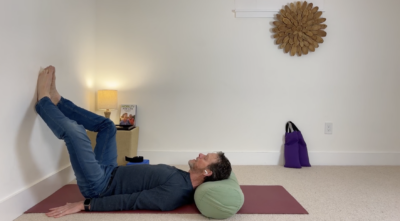
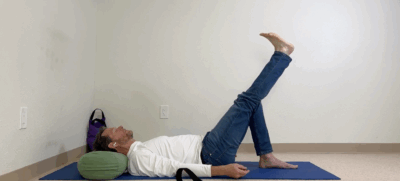
In Avita Yoga, we explore this through simple, effective shapes that allow the deeper lines of support to reveal themselves—without force, and without performance or competition.
If you’re curious to explore this for yourself, you’re always welcome to join a class.
👉 Here’s a link to a 30-minute class—the first of a three-part series on the inner line of the body.
Helpful Q&A
What is the inner line of the body?
The inner line of the body is a continuous line of support that runs from the inner ankle, through the pelvic floor and front of the spine, and up through the crown of the head. It helps organize posture and movement from within rather than relying on muscular bracing.
Is the core the abdominal muscles?
In many traditional models, the core is associated with the abdominal muscles. In Avita Yoga, the core is better understood as the front of the spine and the deeper lines of support that organize the body.
Why is spinal movement important?
Spinal movement helps keep the vertebral joints responsive, clean, and well-nourished. Without movement, stiffness and compression can increase, which may contribute to discomfort over time. The entire spine is designed to move in many different ways, and Avita Yoga is especially good at finding the parts that don’t move.